
RBA raises the cash rate to 4.85%: what it could mean for you
Inflation is still running well above the RBA's 2–3% target. Consumer prices rose 4.3% over the year to September, with underlying inflation at 3.6% (ABS September 2026).
Higher fuel and energy costs are part of the story, but the RBA also noted that price pressures are broad-based across the economy. It now expects inflation to stay elevated through much of 2027, around three quarters longer than it forecast in August, and is concerned that higher inflation could become embedded.
At the same time, there are signs that higher interest rates are already slowing parts of the economy. Housing prices have fallen and unemployment has risen, while the RBA expects economic growth to slow further over the coming year.
There is still considerable uncertainty around the interest rate outlook.
The four major banks currently have 4.85% as the peak cash rate in their base forecasts. However, further rises have not been ruled out.
ANZ has flagged a material risk that the cash rate could reach 5.10% between December 2026 and February 2027, while Westpac has indicated that the risk of another increase in February has grown.
Current forecasts from CommBank, NAB and Westpac point to possible rate cuts from around August 2027, while ANZ’s forecast has the first cut in November 2027.
These forecasts can change quickly. Inflation, energy prices, employment, household spending and other economic data will influence the RBA’s decisions from here.
If your lender passes the full 0.25 percentage point increase on to your variable loan, your interest costs will rise again.
For example, for an interest-only loan of $1 million, a 0.25% increase equates to approximately $2,500 more interest a year, or $208 more a month.
On the same loan, the five 2026 rate rises would add approximately $12,500 a year, or just over $1,040 a month, in interest. Together, those rises total 1.25 percentage points.
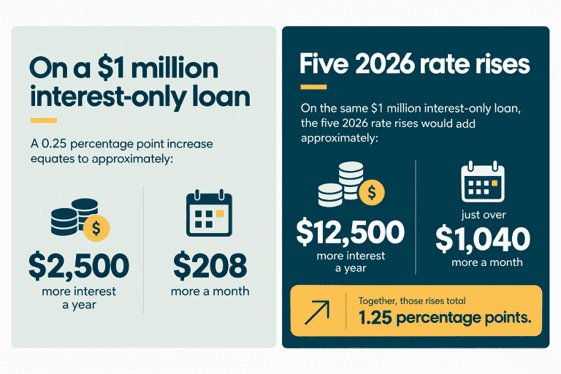
These figures are simple illustrations before tax and assume each increase is passed on in full.
For property investors, interest on a loan used to buy a rental property is generally tax deductible while the property is rented or genuinely available for rent. The new negative gearing rules may affect your ability to claim a tax deduction for your residential rental loss, depending on when you bought the property. Your circumstances and loan structure will determine the tax treatment and we recommend speaking with your Boyce advisor.
Offset and redraw balances may also provide some borrowers with a buffer against higher interest costs.
If you are thinking about selling a property because of interest rates or capital gains tax (CGT) rules, speak with your Boyce advisor first. The most suitable option will depend on your individual circumstances.
While rising rates increase borrowing costs, they can also increase the income available from some investments.
You should seek qualified advice to determine your investment timeframe, liquidity requirements, tax and the role of the investment within your broader portfolio before investing.
A change in the cash rate does not necessarily mean you should make an immediate change to your loan or investments.
It does provide a useful reason to review whether your current arrangements still suit your circumstances.
For borrowers: it may mean considering the effect of higher repayments on cash flow, reviewing your loan structure and understanding the value of any offset or redraw balances.
For investors: it may mean reviewing how much cash you hold, the income available from different investments and whether taking additional investment or liquidity risk is appropriate for the extra return being offered.
If you would like to understand what the latest rate rise means for your finances, please get in touch with your Boyce advisor or your local Boyce office.
This information is general in nature and does not take into account your objectives, financial situation or needs. It is not a recommendation to buy, sell or hold any security. You should consider your individual circumstances and obtain professional advice before making financial decisions. Past performance is not a reliable indicator of future performance.